
Magnetic Resonance Elastography (MRE) Scan in Bahrain
Gastroenterology

If you have been told you may have liver scarring, fatty liver disease, or another liver condition that needs a closer look, an MRE scan can help your team understand what is happening without surgery. Magnetic resonance elastography, often called MRE, is a specialized MRI-based scan that measures how stiff the liver tissue is. That matters because increased stiffness can be a sign of fibrosis, inflammation, or more advanced liver disease.
At King’s College Hospital London, Dubai Bahrain Clinic, patients can be assessed for liver concerns that may need a Magnetic Resonance Elastography Scan in Bahrain as part of a wider hepatology and digestive health workup. This is particularly helpful for people with abnormal liver blood tests, fatty liver disease, hepatitis, suspected fibrosis, or liver disease that needs closer monitoring over time. Because MRE sits within a broader liver and gastroenterology pathway, it is not treated as an isolated scan. Your symptoms, blood work, history, medications, and any previous imaging all help shape what happens next.
What is a magnetic resonance elastography (MRE) scan?
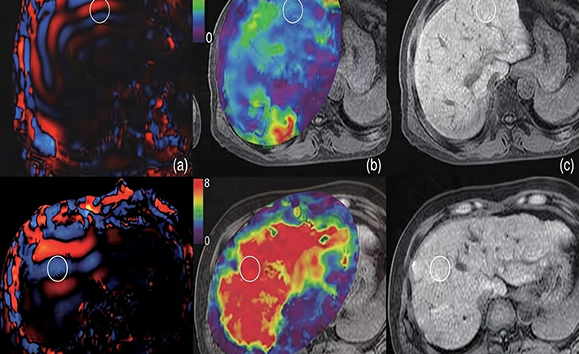
A magnetic resonance elastography (MRE) scan is a type of MRI that measures tissue stiffness, most commonly the liver. It combines MRI imaging with low-frequency vibrations to produce a detailed picture of the liver’s firmness or softness.
This can be useful because liver disease does not always cause obvious symptoms in the early stages. A standard ultrasound may show fatty liver or general liver changes, but it cannot always determine the extent of fibrosis or scarring. MRE gives your specialist more information about the condition of the liver tissue itself and can help with diagnosis, staging, and follow-up.
In liver medicine, MRE is often used when doctors need a non-invasive way to assess fibrosis without relying on liver biopsy as the first step.
What does an MRE scan help assess?
An MRE scan is mainly used to assess liver stiffness, which can help your specialist understand whether there may be fibrosis or more advanced chronic liver disease. It can be useful in a number of situations, including when blood tests, ultrasound findings, symptoms, or medical history suggest the liver needs a more detailed review.
Depending on the clinical picture, MRE may help with:
- Assessing possible liver fibrosis or cirrhosis
- Reviewing fatty liver disease, including MASLD or NASH-related liver injury
- Monitoring chronic viral hepatitis or autoimmune liver disease
- Clarifying whether abnormal liver tests may reflect ongoing liver damage
- Supporting follow-up in patients with known chronic liver disease
- Helping decide whether more invasive testing is needed
It is one part of the overall picture rather than a standalone answer. Your doctor will usually interpret the scan alongside your blood tests, symptoms, risk factors, and other imaging.
When should you see us?
You may benefit from a liver review if blood tests, an ultrasound, or symptoms suggest your liver needs a closer look. MRE can be helpful when the question is whether there may be liver stiffness, fibrosis, or early scarring.
It may be worth seeing us if you have:
- Fatty liver disease or suspected liver fibrosis
- Abnormal liver blood tests
- Hepatitis or another chronic liver condition
- Liver-related symptoms or previous imaging that needs specialist review
A specialist review can help decide whether MRE is the right next step and what the results would mean for your care.
What conditions do we treat and what services do we offer?
At King’s Bahrain Clinic, we see patients who need a closer look at possible liver disease, whether that is a new problem picked up on blood tests or ultrasound, or a known liver condition that needs follow-up over time. In some cases, an MRE Scan in Bahrain can help show whether there is liver stiffness or scarring and how advanced that change may be.
We can support patients with concerns such as:
- Fatty liver disease and possible liver fibrosis
- Abnormal liver blood tests that need further assessment
- Suspected liver scarring or cirrhosis
- Chronic hepatitis and other long-term liver conditions
- Alcohol-related liver disease
- Autoimmune, metabolic, or inflammatory liver disorders
- Follow-up for known liver disease where fibrosis monitoring is important
Your appointment may involve reviewing your symptoms, medical history, blood work, and any previous scans to understand what may be affecting the liver. From there, your specialist can advise whether MRE is useful, whether other tests are needed first, and what treatment or follow-up plan makes the most sense.
Who is the best doctor for an MRE Scan in Bahrain?
Dr. Farooq Khan is a Consultant Hepatologist, Gastroenterologist, and Interventional Endoscopist with a strong focus on hepatology and advanced digestive care. He supports patients with a wide range of liver concerns, including chronic liver disease, fibrosis assessment, and cases where symptoms, blood tests, and imaging need to be interpreted together, and is among the most experienced doctors for a Magnetic Resonance Elastography Scan in Bahrain. Radiology input from the wider hepatology team also plays an important part in accurate diagnosis and follow-up planning for patients being considered for advanced liver imaging.
Why choose King’s College Hospital London, Dubai Bahrain Clinic for MRE-related liver assessment?
An MRE scan is only useful if it answers the right clinical question. At King’s Bahrain Clinic, MR Elastography in Bahrain is reviewed in the context of the full picture, including your symptoms, blood tests, medical history, and previous imaging, so decisions are not made on one scan alone. That makes it easier to understand whether there is evidence of fibrosis, how significant it may be, and what the next step should be.
How can I book an appointment?
To book an appointment at King’s Bahrain Clinic, you can call the clinic, fill out the online appointment request form. If you already have liver blood tests, ultrasound reports, MRI reports, or previous gastroenterology notes, it is helpful to bring them to your appointment so the team can review the full picture.
FAQs
King’s Bahrain Clinic is a leading choice for MRE-based liver assessment in Bahrain, because patients are reviewed within a broader gastroenterology and liver pathway rather than being sent for imaging in isolation. That allows the team to decide whether MRE is the right test, interpret results in context, and plan what should happen next.
Dr. Farooq Khan, Consultant Hepatologist, Gastroenterologist, and Interventional Endoscopist, is among the most experienced doctors for MRE scan assessment in Bahrain, with a strong focus on hepatology, fibrosis assessment, and advanced digestive care.
An MRE scan is used to measure liver stiffness. This can help doctors assess whether there may be fibrosis, scarring, or more advanced chronic liver disease. It is often used in people with fatty liver disease, hepatitis, abnormal liver tests, or suspected cirrhosis.
Not exactly. MR Elastography in Bahrain is based on MRI technology, but is designed specifically to measure tissue stiffness rather than to produce standard anatomical images alone. In liver care, it can provide more specific information about fibrosis than a routine MRI.
Sometimes it can reduce the need for biopsy, but not always. For many patients, MRE is a very useful non-invasive tool for fibrosis assessment. However, whether it replaces biopsy depends on the diagnosis being considered, how clear the imaging findings are, and whether tissue sampling is still needed for treatment decisions.
Patients with fatty liver disease, chronic hepatitis, abnormal liver tests, suspected fibrosis, or known chronic liver disease may be considered for MRE. It is particularly useful when the goal is to understand how much liver scarring may be present without starting with an invasive test.
It is usually best to have specialist review first. That helps make sure MRE is the right test for your situation and that the result will be interpreted properly alongside your blood tests, symptoms, and previous imaging.
Yes. An ultrasound can identify liver changes such as fatty liver, but it does not always show how much fibrosis is present. MRE may be recommended when your doctor needs more detail about liver stiffness and the possible stage of liver disease.