Bow Legged: Causes, Symptoms, Treatment & When to See a Doctor
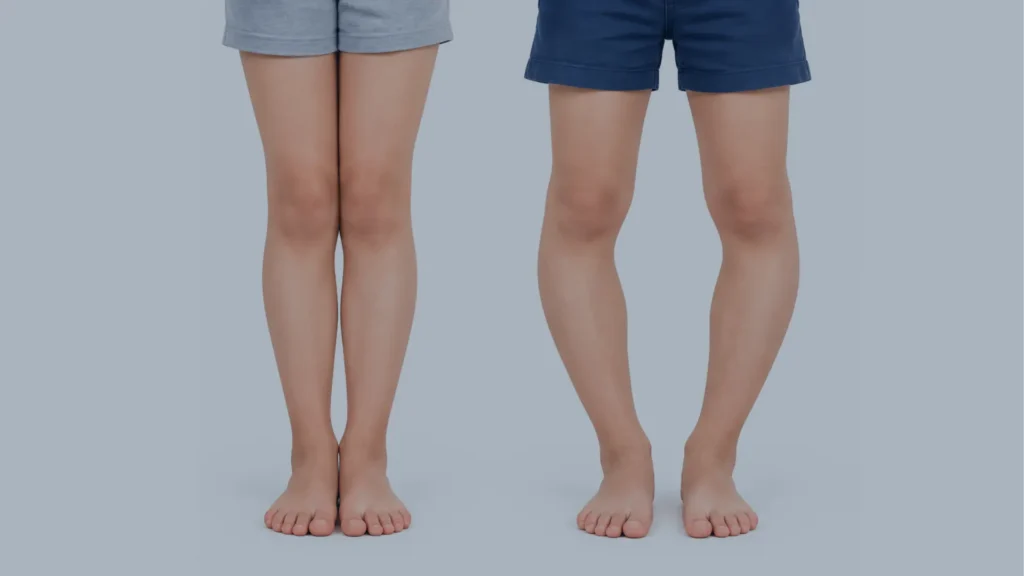
Have you noticed your child’s legs curving outward when they stand or walk? Or perhaps you’ve started experiencing knee pain and wondered if your leg alignment could be the cause?
While bow legged alignment is often a normal part of early childhood development, persistent or worsening bowing may sometimes indicate an underlying orthopedic condition that requires medical attention.
At King’s College Hospital London Dubai – Bahrain Clinic, patients have access to experienced orthopedic specialists who provide advanced clinical assessment, modern imaging, and patient-centered care for children and adults to achieve better mobility, reduce pain, and protect long-term joint health.
Whether you’re concerned about a bow legged baby, searching for information about bow legged people, or wondering how to correct bow legs in adults, this guide covers everything you need to know, from causes and symptoms to diagnosis and treatment options.
What does Bow Legged (Genu Varum) mean?
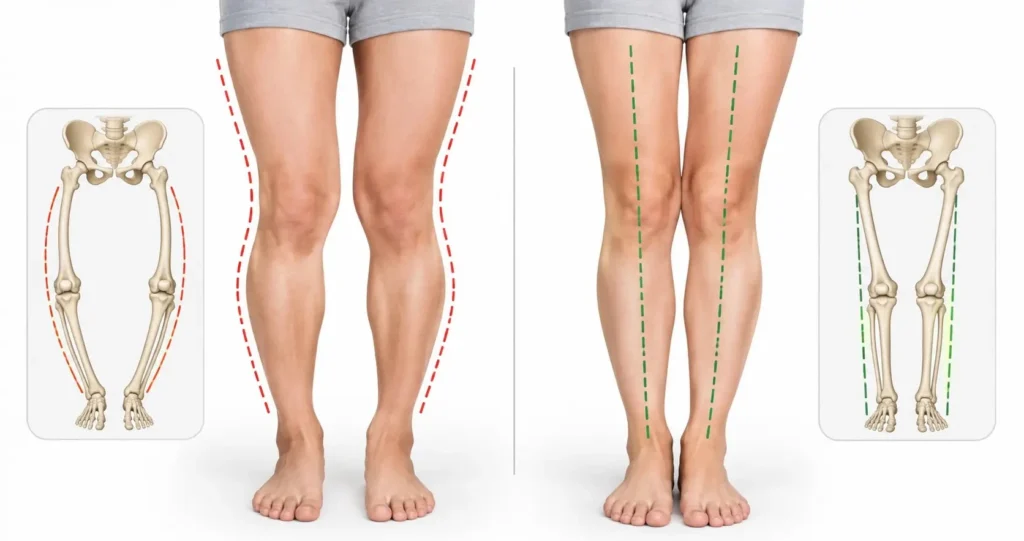
Bow legged, or genu varum, is a condition where the legs curve outward, creating a noticeable gap between the knees while the ankles remain close together when standing with the feet together.
In normally aligned legs, the hips, knees, and ankles share body weight evenly. With bow legs, this alignment changes, placing additional stress on certain parts of the knee joint. Over time, especially in untreated adults, this uneven distribution of weight may contribute to joint pain, reduced mobility, and early cartilage wear.
Although bowlegged alignment is often easy to recognize, not every case requires treatment. The significance of the condition depends on several factors, including:
- Age
- Severity of the curve
- Whether one or both legs are affected
- Presence of pain or walking difficulties
- The underlying cause
Quick Fact: Genu varum is one of the most common leg alignment variations seen during infancy. In most healthy children, it improves naturally as the bones develop. |
Is BowLegged normal? A guide by age
The answer depends largely on a person’s age and the reason behind the curved legs. While bow legs are often considered a normal stage of development in infants, persistent bowing or new-onset bowing later in life deserves medical evaluation.
Bow Legged in Babies
Nearly every baby is bow legged to some degree. This is a normal result of how the legs are folded in the womb, and it is not a cause for concern in a healthy, growing baby.
Bow Legged in Toddlers
As toddlers start walking and bearing weight, the bowing typically improves on its own between 18 months and 3 years of age. By age 3 to 4, most children’s legs have straightened into a normal alignment, and some may briefly swing the other way into mild knock knees before settling.
Bow Legged beyond early childhood
As children grow, their leg alignment naturally changes. Mild bow legs often begin to correct during toddlerhood and continue to improve throughout early childhood.
However, persistent genu varum may require further assessment if:
- The bowing becomes more pronounced over time
- Only one leg appears affected
- The child experiences pain while walking
- Growth appears delayed
- The child has difficulty keeping up with age-appropriate physical activities
Early assessment helps identify whether the condition represents normal development or an underlying orthopedic disorder requiring treatment.
Bow Legged in adults
Bow legged in adults is almost never a leftover growth pattern. It usually reflects an old injury, long-standing arthritis, or a bone condition that has changed the shape or alignment of the leg over time, which is why adults asking how to correct bow legs need a proper diagnosis rather than a generic exercise plan.
Signs and symptoms of Bow Legs
The appearance of curved legs is usually the first noticeable sign, but bow legs may also affect movement, posture, and joint health over time.
Some people have bowed legs with no symptoms at all beyond the visible curve and a gap between the knees. Others notice:
- An uneven or waddling walking pattern
- Knee pain, especially on the inner side of the joint
- Hip or ankle discomfort from altered weight distribution
- Difficulty running or keeping up during physical activity
- Joint stiffness that builds up through the day
Pain, stiffness, or a worsening walking pattern are signs that the bowing is more than a cosmetic feature and warrants medical attention.
Why do Bow Legs develop? Understanding the root causes
Not all bow legs have the same cause. In some individuals, the condition is a normal developmental phase, while in others, it may result from an underlying medical problem affecting bone growth or joint health.
Identifying the cause is one of the most important steps in deciding whether treatment is needed.
1. Physiological Bowing (Normal Development)
This is the most common cause of bowlegged alignment in infants.
Physiological bowing occurs naturally because of fetal positioning before birth. As children grow, the bones gradually remodel, and the legs usually straighten without medical intervention.
These children generally have:
- Symmetrical bowing
- Normal growth
- No pain
- Normal physical activity
Observation and regular follow-up are often all that’s required.
2. Blount Disease
Blount disease is a growth disorder affecting the upper part of the shinbone (tibia).
Instead of growing evenly, the growth plate develops abnormally, causing progressive bow legs that become more noticeable over time.
The condition may occur during early childhood or adolescence and is more likely to progress without treatment.
Unlike physiological bowing, Blount disease typically does not improve on its own.
3. Vitamin D Deficiency and Rickets
Healthy bones require adequate vitamin D and calcium for normal growth.
A deficiency in vitamin D may lead to rickets, a condition in which growing bones become soft and weak. As children begin bearing weight, the weakened bones may gradually curve, resulting in genu varum.
In these cases, early diagnosis and appropriate nutritional treatment can help improve bone health and prevent further complications.
4. Previous Bone Injuries
Fractures involving the growth plates or poorly healed leg injuries may alter normal bone alignment.
Depending on where the injury occurred, healing may leave one leg slightly curved, creating a bow-legged appearance that becomes more noticeable over time.
5. Arthritis and Joint Degeneration
One of the most common causes of bow legged alignment in adults is osteoarthritis.
As cartilage wears away, the inner side of the knee may gradually collapse, causing the legs to angle outward. This creates a cycle where abnormal alignment increases pressure on the knee joint, accelerating arthritis progression.
Many adults seeking advice on how to correct bow legs in adults are found to have underlying degenerative joint disease that requires individualized orthopedic care.
6. Genetic and Bone Disorders
Certain inherited skeletal conditions and rare bone disorders can interfere with normal bone growth and alignment.
Although these conditions are less common, they often require specialist evaluation, particularly when multiple bones are affected or there is a family history of skeletal abnormalities.
Who is more likely to develop Bow Legs?
While bow legged alignment can affect anyone, certain factors increase the likelihood of developing persistent genu varum.
- Being significantly overweight, which increases pressure on the growth plates and joints
- Walking at a very early age, in combination with excess weight
- Nutritional deficiencies, particularly low vitamin D or calcium
- A family history of Blount’s disease or other bone conditions
- Underlying bone or metabolic diseases
Bow legged – Myth Vs Facts#Myth: Walking early always causes bow legs. Fact: Early walking is only a risk factor combined with issues like excess weight; most early walkers never develop a problem. #Myth: Bow legged always means surgery is needed. Fact: Most bow legged babies and toddlers need nothing more than routine monitoring, since the bowing corrects on its own. #Myth: Special shoes or inserts straighten normal bow legs faster. Fact: No shoe, insert, or home device speeds up the natural straightening process in physiologic bowing. #Myth: Exercises can straighten bowed bones in adults. Fact: Exercise strengthens the muscles around the knee and can ease discomfort, but it cannot reshape bone. Structural correction in adults needs medical or surgical treatment. |
How are Bow Legs diagnosed?
Since bow legs can develop for different reasons, orthopedic specialists first determine whether the condition is part of normal growth or caused by an underlying bone or joint disorder.
At King’s College Hospital London Dubai – Bahrain Clinic, the orthopedic team performs a thorough evaluation to understand the severity of the deformity, identify its cause, and recommend the most appropriate treatment plan.
A comprehensive assessment may include:
- Physical examination – Diagnosis typically starts with a physical exam, measuring the gap between the knees and observing the walking pattern, along with a review of medical and growth history.
- X-ray – A standing X-ray measures the exact angle of bowing and checks the growth plates or joint surfaces.
- Blood tests – If rickets is suspected, blood tests check vitamin D, calcium, and phosphorus levels.
In children, growth is monitored over repeat visits, since the trend over time matters as much as any single measurement.
For detailed pre-surgical planning or pediatric follow-up, low-dose, whole-body EOS imaging, available through King’s College Hospital Dubai’s imaging network, gives a highly detailed, weight-bearing view of the legs with a fraction of the radiation of conventional imaging.
Bow Legged treatment: Finding the right approach
There is no one-size-fits-all treatment for bow legged alignment. The most appropriate option depends on:
- Age
- Severity of the deformity
- Underlying cause
- Symptoms
- Overall bone health
Many children require only careful observation, while others may benefit from bracing, nutritional therapy, or surgery. Adults often need treatment that addresses both the deformity and any associated arthritis or joint damage.
Observation and regular monitoringFor healthy bow legged babies with physiological bowing, orthopedic specialists often recommend observation and periodic follow-up appointments. During these visits, doctors monitor:
In many children, the legs gradually straighten without intervention. | Nutritional treatmentIf genu varum is caused by vitamin D deficiency or rickets, correcting the nutritional imbalance becomes the priority. Treatment may include:
Addressing the underlying deficiency early can help improve bone strength and reduce further deformity. |
BracingCertain children with conditions such as early Blount disease may benefit from specially designed orthopedic braces. Bracing works by guiding bone growth during childhood and is generally most effective when started early before significant deformity develops. Not every child is a candidate, which is why specialist assessment is essential. | Physical therapyAlthough physical therapy cannot permanently straighten structural bow legs, it helps in:
For many bow legged people, physiotherapy improves daily function even when surgery is not required. |
When do you need surgery?
Surgery is considered when:
- Bowing continues to worsen
- Significant pain develops
- Walking becomes difficult
- Joint damage is progressing
- Conservative treatments have not been successful
The goal is to restore proper alignment, reduce abnormal pressure on the joints, and improve long-term mobility.
Common surgical procedures include:
Guided growth surgeryFor growing children, guided growth surgery uses small implants placed near the growth plate to gradually encourage the bones to straighten as the child grows. Because the correction occurs naturally over time, this procedure is often less invasive than corrective surgery performed later in life. | OsteotomyAn osteotomy is more commonly performed in adolescents and adults. During the procedure, the surgeon carefully cuts and realigns the bone before securing it with plates or other fixation devices. For selected patients, an osteotomy can:
|
How to correct Bow Legs in adults?
How to correct bow legs in adults? The answer depends entirely on the cause.
If the bowing is caused by arthritis, previous fractures, or longstanding genu varum, exercises alone cannot permanently change the shape of the bones.
Treatment may include:
- Weight management
- Activity modification
- Physiotherapy
- Pain management
- Orthotic support in selected cases
- Osteotomy for suitable patients
- Knee replacement surgery in advanced arthritis
In adults, rather than focusing on straightening legs, the treatment aims at improving their function, relieving pain, and protecting knee joint from further damage.
Do Bow Leg exercises really work?
Exercises cannot correct structural bone alignment in adults or children with established skeletal deformities.
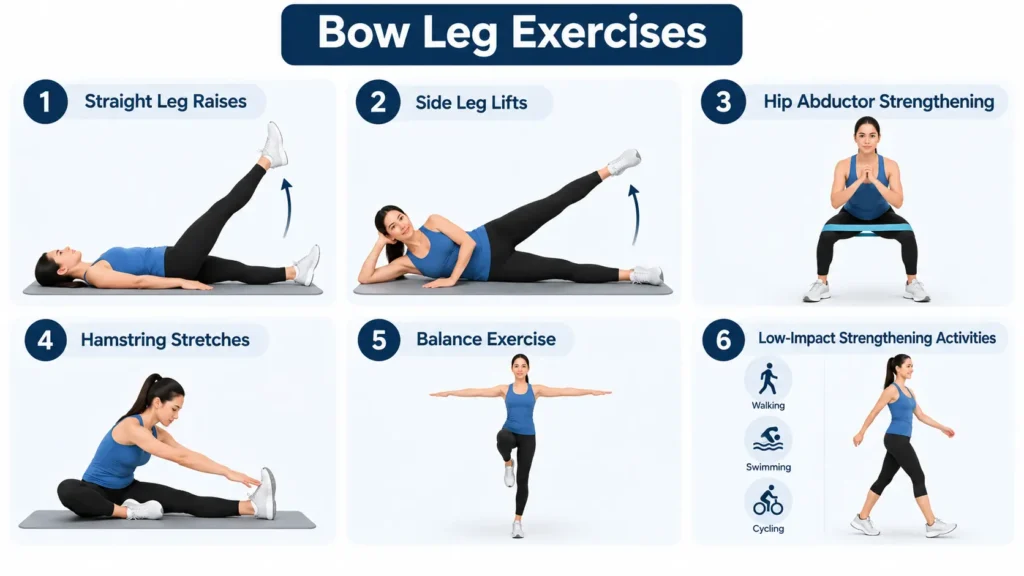
Bow leg exercises can improve hip stability, core strength, balance, flexibility, support healthier walking mechanics, and reduce discomfort due to muscle weakness.
What are the common exercises for bow legs?
Common rehabilitation exercises may include:
Straight leg raises | Side leg lifts | Hip abductor strengthening | Hamstring stretches | Balance exercises | Low-impact strengthening activities |
These exercises should always be performed under the guidance of a physiotherapist, particularly when pain or joint instability is present.
Remember: Exercises support stronger muscles and healthier joints, they do not permanently reshape bones affected by genu varum |
Can Bow Legs correct naturally?
In babies and toddlers, yes. Physiologic bow legs correct naturally through normal growth, with no exercises, braces, or supplements required.
In adults, correction almost never happens naturally, since bowing usually stems from arthritis, an old fracture, or a structural bone issue.
Exercises and weight management can ease pain and slow progression, but a lasting answer to how to correct bow legs in adults usually involves specialist evaluation and, where appropriate, surgical realignment.
When should you see an Orthopedic Specialist?
Although many cases are harmless during infancy, certain warning signs should never be ignored.
- Book an orthopaedic assessment if you notice any of the following:
- Bowing has not started improving by age 2 to 3
- One leg is noticeably more bowed than the other
- The bowing is getting worse, not better
- Pain, limping, or difficulty walking
- Short stature or slowed growth alongside bowing
- Bowing appears suddenly in adulthood
What happens if Bow Legs are left untreated?
Untreated, progressive bow legs can lead to uneven knee wear, accelerated arthritis, ongoing joint pain, an abnormal walking pattern, and reduced mobility over time. In children, deformity left uncorrected while growth remains can also become harder and more invasive to treat later.
Can Bow Legs be prevented?
There is no guaranteed way to prevent every case, particularly those linked to genetics or bone disorders, but nutrition-related bowing can often be avoided with a balanced diet, adequate vitamin D, and regular paediatric check-ups that catch early signs before they progress. Families with a history of Blount’s disease should seek early evaluation, when treatment works best.
Expert Bow Legs Treatment at King's College Hospital London Dubai – Bahrain Clinic
Whether you’re concerned about a bow legged baby, persistent bow legs in a growing child, or looking for how to correct bow legs in adults, the orthopedic specialists at King’s College Hospital London Dubai – Bahrain Clinic provide personalized care based on your age, symptoms, and the underlying cause.
Patients may benefit from:
Comprehensive orthopedic evaluation to accurately diagnose the cause and severity of bow legs | Advanced imaging and diagnostic services for precise treatment planning | Observation and growth monitoring for children with physiological bowing | Nutritional management for bow legs caused by vitamin D deficiency or rickets |
Bracing for eligible children with specific growth-related conditions | Personalized physiotherapy to improve strength, balance, mobility, and joint function | Corrective surgical procedures, including guided growth surgery and osteotomy, when clinically indicated | Long-term follow-up and rehabilitation to support recovery and maintain healthy joint function |
Concerned about bow legs? Book an appointment with the orthopedic specialists at King’s College Hospital London Dubai – Bahrain Clinic for a comprehensive evaluation and personalized treatment plan.
OUR DOCTORS

Dr Vinoda Metta
Consultant - Neurology

Dr Ranjeev Bhangoo
Consultant - Neurosurgery

Dr Imtiaz Ahmed Hashmi
Specialist - Orthopaedic Surgery