Understanding the Stages of Cancer
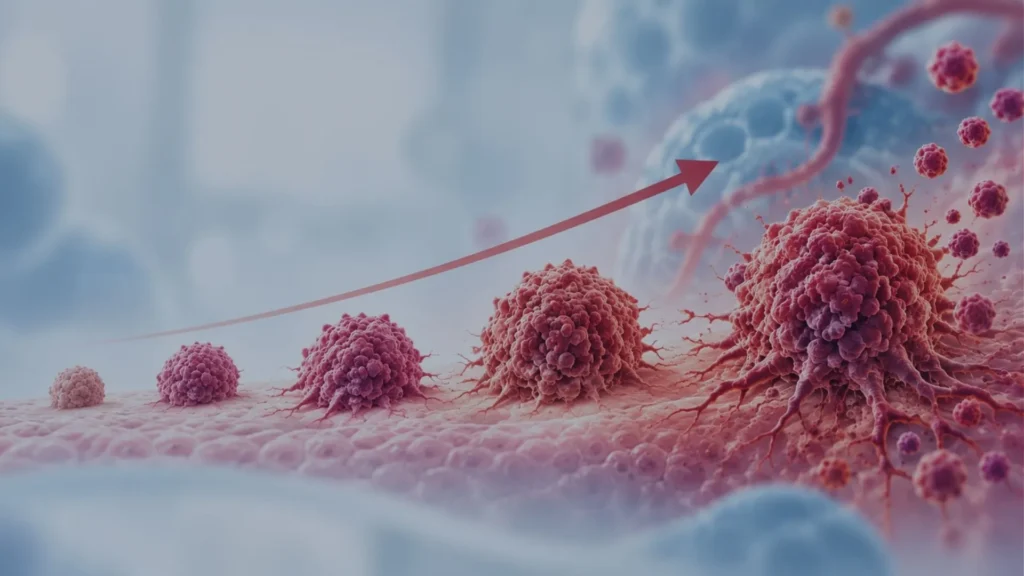
Being told that you or someone you love has cancer can bring a flood of questions. One of the first is often: “What stage is it?”
The term stages of cancer describes how far a cancer has grown and whether it has spread beyond where it first developed. While the word “stage” can sound frightening, it is primarily a clinical tool. Doctors use staging to understand the extent of disease, plan treatment, and discuss what may lie ahead.
At King’s College Hospital Bahrain, cancer care is supported by a multidisciplinary team that includes specialists in oncology and hematology, alongside services for cancer diagnosis, surgery and treatment.
Most importantly, a cancer stage is not the whole story. The type of cancer, its grade, genetic characteristics, overall health and response to treatment can all influence decisions and outlook.
Key takeaways
|
What does “Cancer Stage” actually tell you?
Cancer staging is essentially a map of where the cancer is and how far it has traveled.
For many solid tumors, doctors look at the size or extent of the primary tumor, whether nearby lymph nodes contain cancer cells and whether there is evidence of spread to distant organs. This information may come from physical examination, imaging, laboratory testing and, when appropriate, biopsy or surgery.
It is also worth separating stage from grade
Stage describes the extent and spread of cancer | Cancer grade is based on how the cells look under a microscope and can give doctors clues about how the cancer may grow and behave. |
Important to Know A higher stage does not simply mean that a cancer is “worse” in every possible sense. Different cancers behave differently, and the meaning of a particular stage depends heavily on the cancer type. For example, stage 2 breast cancer and stage 2 colon cancer are not identical conditions and should not be interpreted in exactly the same way. |
How many stages of cancer are there?
For many cancers, there are four main numbered stages: stage 1, stage 2, stage 3 and stage 4. Some cancers also use stage 0, making five broad categories.
The stages are sometimes written using Roman numerals: I, II, III and IV. However, there is no universal staging formula that applies identically to every cancer. Some cancers are divided into additional groups such as stage IIA, IIB or IIIA, while others use completely different classification systems.
Here is a general overview of the different stages of cancer:
Stage | What it generally means | What doctors may be assessing |
Stage 0 | Abnormal cells remain within the tissue where they developed and have not invaded nearby tissue | Whether abnormal or cancerous cells are confined to their original layer |
Stage 1 | Usually a relatively small, localized cancer | Tumor size and whether it has remained confined to the original organ |
Stage 2 | Cancer may be larger or have greater local involvement | Tumor size, local invasion and, for some cancers, nearby lymph nodes |
Stage 3 | More extensive local or regional disease | Involvement of surrounding tissues and/or regional lymph nodes |
Stage 4 | The cancer has moved beyond the original site to distant areas of the body. | Distant metastasis and which organs or tissues are affected |
These descriptions are deliberately broad because the exact criteria vary considerably by cancer type.
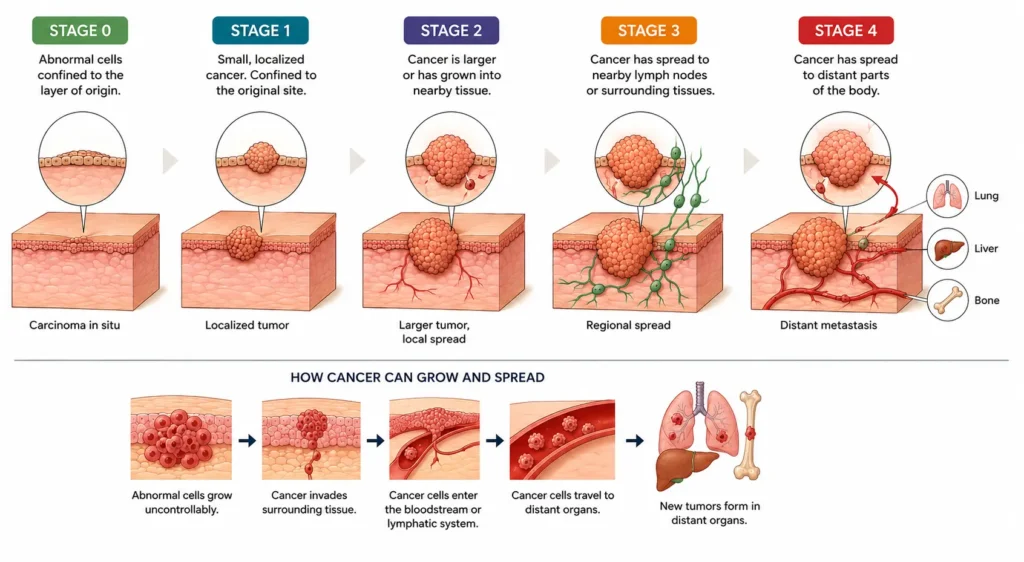
Stage 0: Abnormal cells that have not invaded nearby tissue
Stage 0 is sometimes called carcinoma in situ. At this point, abnormal cells are present but have not invaded surrounding tissue. In some circumstances, these changes may eventually develop into invasive cancer if left untreated, although the precise meaning depends on the cancer type.
Stage 0 is not used for every cancer, and its significance differs between conditions. Your doctor will explain what the finding means for the specific organ involved.
Stage 1 Cancer: Usually localized disease
Stage 1 cancer generally refers to a relatively small cancer that remains localized to the place where it began.
This is often considered an early stage, but “stage 1” does not mean every cancer is identical or that treatment will always be simple. Tumor biology, location and other clinical features still matter.
Treatment at this stage may involve surgery, radiation therapy, systemic treatment or a combination, depending entirely on the cancer type.
Stage 2 Cancer: More local growth, but not necessarily distant spread
Stage 2 cancer often indicates that the tumor is larger or has grown more deeply into nearby tissue than a stage 1 cancer.
For some cancers, nearby lymph nodes may also be involved at this stage. In others, lymph node involvement may move the cancer into a later stage. This is one reason it is unsafe to assume that a particular stage has exactly the same meaning across all cancers.
Patient Tip If your report says “stage 2,” ask your oncologist to explain the specific TNM classification, tumor characteristics and whether lymph nodes are involved. These details often provide much more information than the stage number alone. |
Stage 3 Cancer: More extensive local or regional disease
Stage 3 cancer generally means the cancer has become more extensive within the area where it started and may have spread into nearby tissues or regional lymph nodes.
It does not automatically mean distant metastasis. In many cancers, stage 3 remains different from metastatic stage 4 disease because the cancer has not spread to distant organs.
Treatment can become more complex at this point. Depending on the cancer, doctors may combine surgery with systemic treatment, radiation therapy or other approaches to control disease locally and throughout the body.
Stage 4 Cancer: When cancer has spread to distant organs
Stage 4 cancer means that cancer has spread from its original site to a distant part of the body. This process is called metastasis.
The secondary cancer remains the same type of cancer as the original tumor. For example, if breast cancer spreads to the liver, it is metastatic breast cancer rather than primary liver cancer.
Stage 4 cancer can be serious, but it should not be interpreted as meaning that treatment is impossible. Depending on the cancer type and its biology, treatment may aim to control the disease, slow its progression, relieve symptoms, prolong survival and maintain quality of life.
Important to Read- A diagnosis of stage 4 cancer should never be reduced to a single number or assumption about how much time someone has. Outcomes can differ greatly between cancer types and between individual patients. Modern cancer care may include several treatment strategies, selected according to the cancer’s location, molecular characteristics, previous treatment and the person’s overall health. |
How do doctors determine cancer stage?
Staging usually involves putting several clinical findings together. Depending on the cancer, your medical team may use:
- Physical examination and medical history
- Blood and laboratory tests
- Imaging such as CT, MRI, PET or ultrasound
- Endoscopy for cancers affecting certain organs
- Biopsy to examine cancer cells under a microscope
The TNM system is widely used for many solid tumors. “T” describes the primary tumor, “N” describes nearby lymph node involvement, and “M” describes whether there is distant metastasis.
For example:
- T = How large is the tumor, and how far has it grown locally?
- N = Are nearby lymph nodes involved?
- M = Has the cancer spread to distant parts of the body?
These letters may be followed by numbers or additional letters to provide more detail.
Did You Know? Not every cancer uses the traditional stage 1–4 system. Leukemia, for example, generally does not form a single solid tumor that can be staged in the same way. Some lymphomas and gynecological cancers also use specialized staging systems. |
Does the cancer stage change after treatment?
This can be confusing for patients. Generally, the original stage assigned at diagnosis remains the cancer’s initial stage. If the cancer later responds to treatment, doctors may describe the disease as being in remission or as having no evidence of disease rather than changing the original diagnosis to a lower stage.
Similarly, if a cancer later spreads, doctors may describe the recurrence or metastasis without simply rewriting the original stage.
Your medical team may also use terms such as:
- Localized: confined to the area where it began
- Regional: involving nearby tissues or lymph nodes
- Distant: spread to distant organs or tissues
- Remission: signs and symptoms of cancer have decreased or disappeared, depending on the context
- No evidence of disease (NED): no detectable cancer is identified with the available evaluation
These terms describe different aspects of the disease and should not be treated as interchangeable.
Does a higher stage always mean a poorer outcome?
Stage is an important part of understanding prognosis, but it is not a prediction made from the stage number alone.
Two people with the same stage of the same cancer may have different cancer treatment plans and different outcomes because other factors matter. These can include:
- Cancer type and subtype
- Tumor grade
- Molecular or genetic characteristics
- Exact location of the tumor
- Overall health and other medical conditions
What happens after cancer is staged?
Once the extent of cancer is understood, the oncology team can develop a treatment strategy.
At King’s College Hospital Bahrain, oncology services include chemotherapy and targeted therapies, while the hospital also covers cancer surgery, breast cancer surgery and reconstructive procedures among its cancer services.
The appropriate treatment depends on the individual diagnosis. A patient with localized cancer may be considered for treatment intended to remove or eradicate the disease, while treatment for metastatic cancer may focus on controlling cancer growth, reducing symptoms and supporting quality of life.
The goal is not simply to treat a “stage.” It is to treat the individual cancer and the person who has it.
Understanding cancer stages without losing sight of the person
Learning about the stages of cancer can make a frightening diagnosis feel more understandable. Stage 1, stage 2, stage 3 and stage 4 provide a broad framework for describing how far many cancers have progressed, while stage 0 may describe abnormal cells that have not invaded surrounding tissue.
But a stage number is only one part of the clinical picture.
The most useful next step is to understand what your particular stage means for your type of cancer, whether lymph nodes or distant organs are involved, and how those findings influence treatment choices.
At King’s College Hospital Bahrain, patients can access multidisciplinary oncology and hematology expertise, with care designed around diagnosis, treatment and ongoing clinical support.
FAQs
For many solid cancers, the main stages are 1 through 4, with stage 0 used for certain abnormal or non-invasive cell changes. The exact definition of each stage varies by cancer type.
Most solid cancers use four main numbered stages: stage 1, 2, 3 and 4. Some cancers also use stage 0, while others use specialized staging systems rather than the standard numbered approach.
No. Stage 4 indicates distant spread, but it does not automatically mean that treatment cannot help. Depending on the cancer, treatment may control the disease, relieve symptoms and sometimes provide long-term disease control.
Stage describes how far the cancer has grown or spread. By examining cancer cells under a microscope, doctors can determine their grade, which provides clues about the likely behavior of the cancer.
Yes. At the time of staging, stage 2 cancer has not yet met the criteria for distant spread, but that does not mean cancer cannot progress or return after diagnosis. The risk varies significantly by cancer type.
TNM stands for tumor, nodes and metastasis. It looks at the size of the original tumor, whether nearby lymph nodes are affected, and whether the cancer has spread to other parts of the body.
OUR DOCTORS

Dr Vinoda Metta
Consultant - Neurology

Dr Ranjeev Bhangoo
Consultant - Neurosurgery

Dr Imtiaz Ahmed Hashmi
Specialist - Orthopaedic Surgery