Bell’s Palsy vs Stroke: How to Tell the Difference?
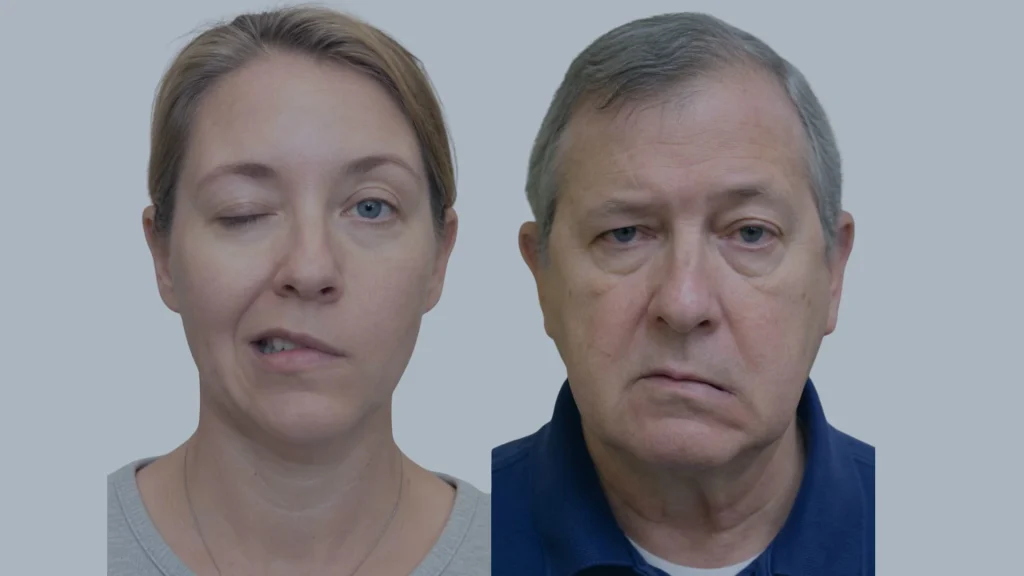
A sudden drooping on one side of the face can be frightening. Many people immediately worry about a stroke, while others assume it may be a temporary nerve issue. The challenge is that both conditions can look similar at first glance.
Understanding Bell’s palsy vs stroke is crucial because one is a neurological emergency that requires immediate treatment, while the other is usually temporary and often resolves over time.
At Kings College Hospital – Bahrain, patients frequently present with sudden facial weakness, and one of the first priorities is determining whether the symptoms indicate Bell’s palsy or a stroke. Although both affect facial movement, they involve different parts of the nervous system and require very different management.
This guide explains Bell’s palsy vs stroke symptoms, causes, warning signs, diagnosis, treatment, and when to seek urgent medical care.
Understanding Bell’s Palsy vs Stroke
While facial drooping can happen in both cases, their origins are different:
- Bell’s palsy is caused by inflammation of the facial nerve (cranial nerve VII)
- Stroke occurs due to reduced or blocked blood flow to the brain
This difference is clinically important. Bell’s palsy affects the peripheral nerve, while stroke affects the brain itself.
Another key difference: Bell’s palsy usually develops gradually over hours, whereas stroke symptoms often appear suddenly and simultaneously.
What is Bell’s Palsy?
Bell’s palsy is a temporary condition that causes sudden weakness or paralysis on one side of the face. It happens when the facial nerve becomes inflamed, compressed, or irritated.
Although the exact cause is not always clear, it is often linked to viral infections.
Common causes of Bell’s Palsy
- Herpes simplex virus
- Viral respiratory infections
- Influenza
- Diabetes-related nerve inflammation
- Pregnancy (especially the third trimester)
- Immune system reactions
Bell’s palsy affects approximately 15-30 people per 100,000 each year, making it the most common cause of sudden facial paralysis worldwide.
What is a Stroke?
A stroke occurs when the blood supply to part of the brain is interrupted. This prevents brain cells from receiving oxygen, leading to rapid damage.
There are two main types:
Ischemic stroke
Caused by a blocked artery (most common)
Hemorrhagic stroke
Caused by bleeding in the brain
Unlike Bell’s palsy, stroke symptoms extend beyond facial weakness and may affect speech, vision, balance, and limb movement.
Globally, stroke is a leading cause of disability and death. Early treatment within the first few hours can significantly improve outcomes.
Bell’s Palsy vs Stroke symptoms: Key differences
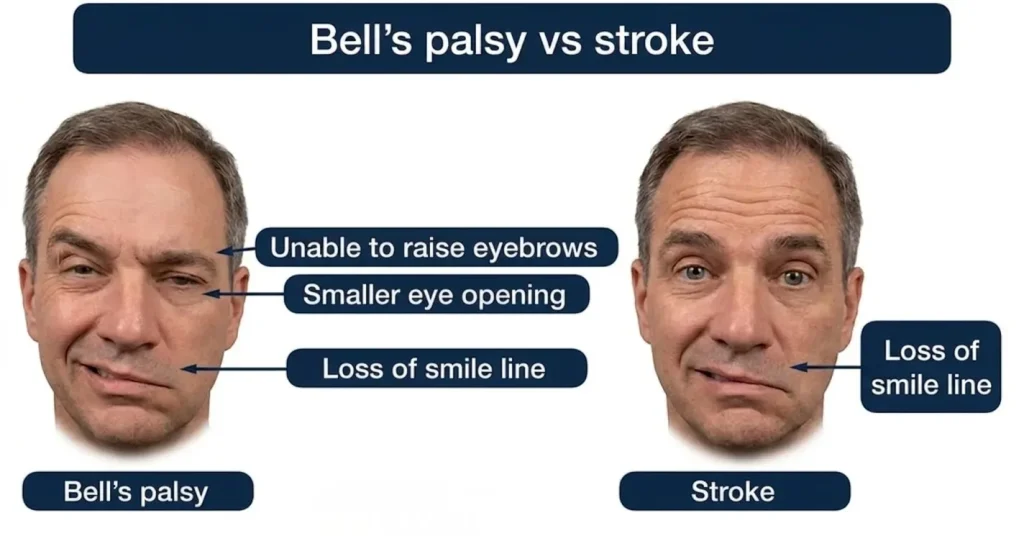
Recognizing symptoms quickly can be lifesaving. The most important difference is forehead involvement.
In Bell’s palsy, the entire side of the face is affected.
In a stroke, the forehead is usually spared.
Feature | Bell’s Palsy | Stroke |
Onset | Gradual (hours to 1-2 days) | Sudden (minutes) |
Facial weakness | One entire side | Usually lower face only |
Forehead movement | Cannot raise an eyebrow | Forehead usually normal |
Eye closing | Difficult or impossible | Usually preserved |
Speech difficulty | Rare | Common |
Arm or leg weakness | No | Often present |
Confusion | No | May occur |
This distinction is central when comparing stroke vs Bell’s palsy clinically.
Why does a stroke spare the forehead?
The brain controls facial muscles differently:
- The upper face receives signals from both sides of the brain
- The lower face receives signals from one side only
When a stroke affects one side of the brain, the forehead still receives signals from the other side. This is why patients with stroke can usually raise both eyebrows, but still have drooping around the mouth.
In Bell’s palsy, the facial nerve itself is affected after it exits the brain, so the entire side of the face is paralyzed, including the forehead.
Symptoms of Bell’s Palsy
Symptoms usually worsen over 24-72 hours.
Common signs include:
- Sudden facial drooping on one side
- Difficulty closing the eye
- Drooping mouth
- Drooling
- Loss of taste
- Ear pain
- Increased sensitivity to sound
- Dry eye
- Watery eye
- Difficulty smiling
Unlike Bell’s palsy vs CVA, Bell’s palsy does not cause limb weakness or confusion.
Symptoms of Stroke
Stroke symptoms typically appear suddenly and worsen quickly.
Warning signs
- Facial drooping
- Slurred speech
- Arm weakness
- Sudden confusion
- Vision problems
- Severe headache
- Difficulty walking
- Dizziness
- Loss of coordination
The FAST rule helps identify stroke:
- F – Face drooping
- A – Arm weakness
- S – Speech difficulty
- T – Time to call emergency services
These symptoms distinguish stroke vs Bell’s palsy clearly in emergency settings.
Causes: Bell’s Palsy vs Stroke
Bell’s Palsy causes
- Viral nerve inflammation
- Immune response
- Swelling inside the facial nerve canal
- Nerve compression
Stroke causes
- Blood clots
- High blood pressure
- Atrial fibrillation
- Diabetes
- High cholesterol
- Smoking
- Obesity
Risk factors for stroke increase significantly with age, while Bell’s palsy can affect any age group.
How doctors diagnose Bell’s Palsy and Stroke
Doctors first perform a neurological examination.
They check:
- Eyebrow movement
- Eye closure
- Smile symmetry
- Speech clarity
- Limb strength
- Reflexes
If stroke is suspected, urgent imaging is required.
Diagnostic tests
For suspected stroke:
- CT scan
- MRI brain
- Blood tests
- ECG
- Carotid ultrasound
For Bell’s palsy:
- Clinical diagnosis
- Sometimes MRI (if atypical)
- Blood tests (to rule out other causes)
The goal is to rule out stroke first, since it requires immediate treatment.
Treatment options: Bell’s Palsy vs Stroke
Treatment differs significantly when comparing Bell’s palsy and stroke, because Bell’s palsy focuses on reducing nerve inflammation, while stroke treatment aims to restore blood flow to the brain as quickly as possible.
Treatment for Bell’s Palsy
Most people recover completely with early treatment. Options include:
1. Corticosteroids
- First-line treatment
- Reduce swelling of the facial nerve
- Most effective within 72 hours
- Improves chances of full recovery
2. Antiviral medications
- May be prescribed if viral cause suspected
- Often combined with steroids
- Used in moderate to severe cases
3. Eye protection
- Artificial tears during the day
- Lubricating ointment at night
- Eye patch while sleeping
- Prevents corneal damage
4. Facial physiotherapy
- Facial exercises
- Muscle retraining
- Improves recovery and symmetry
5. Pain management
- Mild pain relievers
- Warm compress
- Facial massage
Treatment for stroke
Stroke is a medical emergency. Treatment depends on stroke type and timing.
1. Clot-busting medication (Thrombolysis)
- Dissolves blood clots
- Must be given within 4.5 hours
- Improves outcomes significantly
2. Mechanical thrombectomy
- Minimally invasive clot removal
- Used for large vessel strokes
- Restores blood flow quickly
3. Blood thinners / antiplatelet therapy
- Aspirin or other medications
- Prevent future strokes
4. Risk factor management
- Blood pressure control
- Cholesterol-lowering medications
- Diabetes management
5. Rehabilitation therapy
- Physical therapy
- Speech therapy
- Occupational therapy
- Helps regain function
Recovery timeline: Bell’s Palsy vs Stroke
| Recovery stage | Bell’s Palsy | Stroke |
| First improvement | 2-3 weeks | Variable |
| Major recovery | 3-6 months | Months to years |
| Full recovery | Common | Not always |
| Long-term disability | Rare | Common |
| Rehab needed | Sometimes | Often Required |
When should you seek emergency care?
You should seek immediate medical attention if facial drooping is accompanied by:
- Slurred speech
- Arm weakness
- Severe headache
- Confusion
- Vision problems
- Balance difficulty
- Sudden onset of symptoms
Even if symptoms seem mild, stroke must be ruled out first.
It is always safer to treat sudden facial weakness as a possible stroke.
Practical patient guidance
If you notice facial drooping:
- Try raising both eyebrows
- Try smiling
- Try closing both eyes
- Check for arm weakness
- Listen for speech changes
If any additional symptoms appear, seek emergency care immediately.
Do not attempt to self-diagnose at home.
Early evaluation is essential for proper treatment.
Bell’s Palsy vs Stroke: Why early evaluation matters
The biggest risk is assuming facial drooping is Bell’s palsy when it is actually a stroke. Stroke treatment is time-dependent, and delays can lead to permanent disability.
Bell’s palsy may seen alarming at first, but it is typically short-lived and treatable. Stroke, however, requires immediate medical intervention.
Recognizing the differences between Bell’s palsy and stroke ensures faster treatment and better outcomes.
Bell’s Palsy vs Stroke - Knowing the difference can save lives
Understanding Bell’s palsy vs stroke is essential because both conditions can present with similar symptoms but require very different responses. Bell’s palsy is linked to the facial nerve and often gets better, whereas a stroke can lead to serious condition that can affects the brain and needs quick action.
If you or someone around you experiences sudden facial weakness, difficulty speaking, or arm weakness, seek emergency care immediately. Prompt evaluation helps rule out stroke and ensures appropriate treatment.
At Kings College Hospital – Bahrain, patients with facial weakness are evaluated quickly using advanced neurological assessment and imaging when needed. Early diagnosis allows clinicians to distinguish stroke vs Bell’s palsy accurately and begin treatment without delay.
If there’s even a small doubt, dont wait and treat facial drooping as an emergency. Acting quickly can protect brain function and significantly improve recovery.
FAQs
Bell’s palsy is usually not life-threatening. However, symptoms can resemble stroke, so medical evaluation is necessary.
No. Bell’s palsy does not cause stroke. They are separate conditions.
Stroke symptoms usually appear suddenly, often within minutes.
Yes. Most stroke patients can still move their foreheads, unlike those with Bell’s palsy.
Most people recover within 3-6 months.
Yes, but the pattern differs in Bell’s palsy vs stroke symptoms.
Yes. Any sudden facial weakness should be treated as a medical emergency until stroke is ruled out.
OUR DOCTORS

Dr Vinoda Metta
Consultant - Neurology

Dr Ranjeev Bhangoo
Consultant - Neurosurgery

Dr Imtiaz Ahmed Hashmi
Specialist - Orthopaedic Surgery