4 Stages of Appendicitis: Signs and Treatment Options
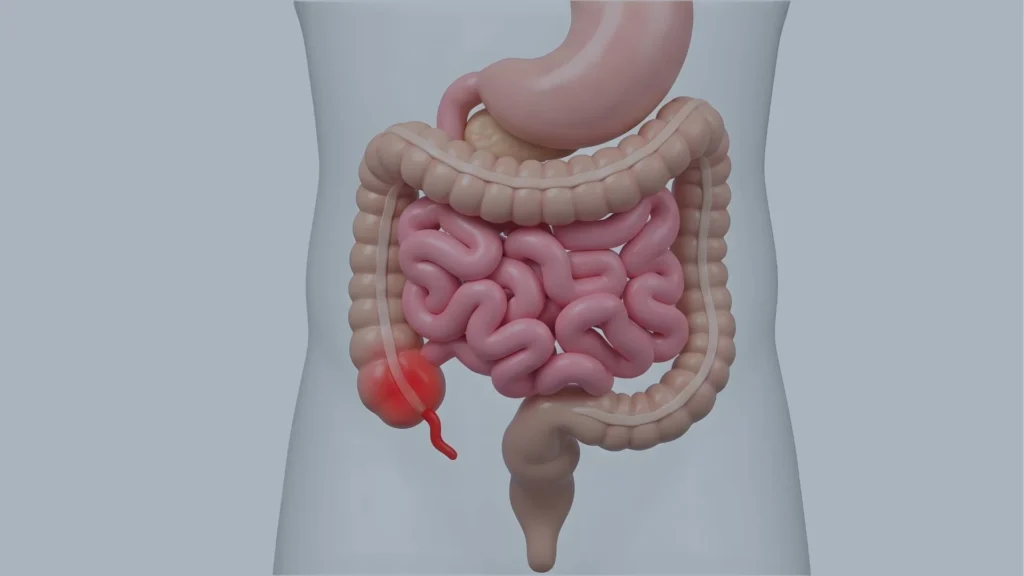
A stomachache may start as a vague discomfort that seems easy to dismiss. But when it comes to appendicitis, that small discomfort can escalate faster than most people expect. Understanding the 4 stages of appendicitis, from the first signs of inflammation to a ruptured appendix, can be the difference between a same-day recovery and a serious complication.
At King’s Bahrain Clinic, part of the King’s College Hospital London Dubai network, patients get rapid, specialist-led evaluation the moment abdominal pain raises concern, backed by direct referral to an experienced surgical team when appendicitis surgery is needed.
This guide walks you through what happens inside the body at each stage, the appendicitis symptoms to watch for, and what your treatment options look like along the way.
Where is the Appendix?
The appendix is a small, finger-shaped pouch attached to the beginning of the large intestine, where the small and large intestines meet. It is usually located in the lower-right abdomen, although its position can vary.
If you are wondering where the appendix is because of abdominal pain, its location can offer a clue, but it cannot confirm appendicitis.
Appendix pain may:
- Start around the belly button and move to the lower-right abdomen
- Worsens with walking, coughing, or movement
- Become persistent rather than coming and going
The pattern can vary depending on the appendix’s position, age, pregnancy, and individual anatomy.
Quick fact: The appendix is not simply “on the right side of the stomach.” It is attached to the cecum, the first part of the large intestine, in the lower-right abdomen |
What happens before the 4 stages of Appendicitis?
Appendicitis usually develops when the opening of the appendix becomes blocked. The blockage can interfere with normal drainage, allowing pressure to build and bacteria to multiply inside the appendix.
As inflammation increases:
Blockage → swelling → bacterial growth → increasing inflammation → possible tissue damage or perforation
The process does not always move at the same speed. Some people may develop significant inflammation quickly, while others may have a less predictable course.
That is why waiting for symptoms to become severe is not a good strategy when appendicitis is suspected.
The four stages of Appendicitis: What's happening inside?
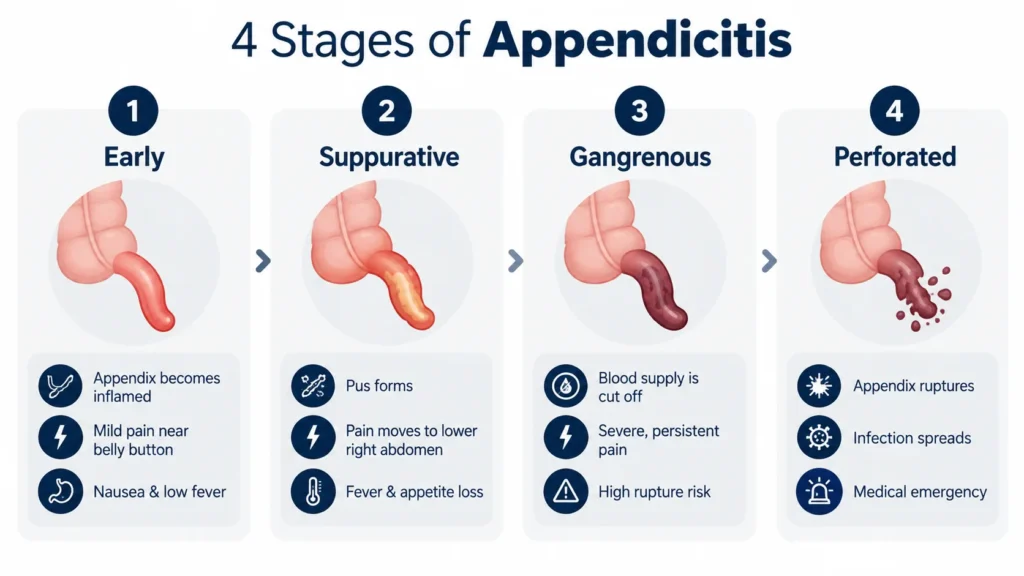
Appendicitis rarely appears overnight and stays mild. It tends to move through four recognizable stages, often within 24 to 72 hours, each one more serious than the last. Knowing these stages helps explain why doctors treat abdominal pain from possible appendicitis as urgent rather than something to “wait and see.”
Stage 1: Early (Catarrhal) Inflammation
- The lining of the appendix becomes inflamed, usually because of a blockage from trapped stool, swollen tissue, or, in rarer cases, a foreign object
- Pain is often mild and vague, felt around the belly button rather than the lower abdomen
- Low-grade fever and mild nausea may appear
- At this stage, symptoms are easy to mistake for indigestion or a stomach bug
Stage 2: Suppurative Appendicitis
- The inflammation intensifies, and pus begins to form inside the appendix wall
- The pain tends to localise and intensify in the lower right quadrant of the abdomen.
- Usually, loss of appetite and fever increase.
- This is typically when patients realize they need medical care because the pain is difficult to tolerate.
Stage 3: Gangrenous Appendicitis
- Blood flow to the appendix is cut off, and the tissues start to die.
- The discomfort is severe and persistent, and may be aggravated by coughing, walking, or sudden movement.
- The risk of the appendix rupturing rises sharply at this point
- Medical evaluation at this stage is considered a true emergency
Stage 4: Perforated (Ruptured) Appendicitis
- The weakened wall of the appendix rips open, and spores of infection pour into the abdominal cavity
- The weakened appendix wall tears, releasing infection into the abdominal cavity
- Discomfort may briefly ease as pressure releases, which is often mistaken for improvement, then returns as generalized abdominal pain and fever
- This stage requires emergency appendicitis surgery and, often, a longer recovery
Quick takeaway: the further appendicitis progresses through these stages, the more complex the surgery and recovery become. Catching it early, ideally in Stage 1 or 2, generally means a simpler procedure and a faster return to normal life. |
Appendicitis symptoms you shouldn't ignore
Recognizing the early signs gives you the best chance of getting treated before complications set in. While every case looks a little different, the following appendicitis symptoms are the most common patterns doctors look for:
- Pain radiating from the belly button and gradually moves to the lower right abdomen
- Pain that gets worse over hours, rather than coming and going
- Fever, often low-grade at first and climbing as the infection progresses
- Nausea or vomiting, usually following the onset of pain
- Loss of appetite
- Pain that worsens with movement, coughing, or pressing on the lower right abdomen
- Bloating or a feeling of abdominal fullness
It’s worth noting that these symptoms can look different in children, older adults, and pregnant women, with pain often higher in the abdomen and milder than expected. If there’s any doubt, it’s always safer to get checked rather than wait it out.
Understanding Appendix pain: What makes it different?
One of the most common questions patients ask is how to distinguish this type of discomfort from a general stomachache or gas pain.
There are a few clues worth knowing:
Location: Stomach pain is a discomfort centred around the stomach, while appendix pain classically starts near the belly button and settles into the lower right abdomen within hours. | Progression: Gas and indigestion usually ease with time or after using the bathroom. This kind of pain tends to steadily worsen instead of coming and going. | Movement sensitivity: The pain often increases with coughing, walking, or gentle pressure on the lower right abdomen, a pattern that doesn’t happen in a routine digestive problem. | Accompanying symptoms: Fever, vomiting, and loss of appetite, alongside abdominal pain, point more strongly toward appendicitis than a simple digestive upset. |
If your discomfort fits this pattern, it’s best to have it assessed promptly rather than waiting to see if it passes.
How is Appendicitis diagnosed?
Doctors use your symptoms, examination, blood tests, and imaging to determine whether appendicitis is likely and whether complications are present.
1. Medical history and examination
Your doctor will ask when the pain starts, whether it’s localized pain, if it has moved, and if the pain is worsening. They will also inquire about changes in appetite, nausea, vomiting, and fever. The abdomen is checked for any swelling and tenderness.
2. Blood tests
Blood tests can detect abdominal infection or inflammation, but it confirm or rule out appendicitis.
3. Imaging
An inflamed appendix and complications like an abscess or perforated appendix can be diagnosed with ultrasound or CT scans. In adults, CT is widely used, and ultrasound may be chosen in certain cases, such as children and pregnant women.
The choice of test depends on your age, symptoms, examination findings, pregnancy status, and overall clinical picture.
Appendicitis treatment: Does everyone need surgery?
Treatment options at each stage:
Treatment for appendicitis depends heavily on which of the 4 stages of appendicitis a patient is in when they seek care, which is exactly why early evaluation matters so much.
Early stage (Stage 1–2)
In select, carefully monitored cases, doctors may consider antibiotics as an initial approach, though surgery remains the standard and most reliable treatment for acute appendicitis. | Suppurative to gangrenous stages (Stage 2–3) Laparoscopic appendectomy, a minimally invasive surgery that uses a few small incisions, is generally the recommended treatment. It usually results in less pain, less scarring, and a shorter recovery time than open surgery. | Perforated stage (Stage 4)
If the appendix ruptures, it may need more immediate surgery, possibly open surgery, and treatment for the infection in the abdomen. Recovery is slow, but timely, specialized treatment will reduce the likelihood of any additional complications. |
In King’s Bahrain Clinic, suspected appendicitis cases are evaluated promptly by clinical examination, blood tests and a review of the diagnostic imaging. When a surgery is needed, patients receive a coordinated referral to the surgical team at King’s College Hospital London in Dubai and benefit from a seamless care pathway from diagnosis through to recovery without prolonged waits.
When to seek emergency care?
However, any worsening abdominal pain, especially if it fits the pattern listed above, should never be ignored. If you observe any of the following, you should request immediate medical evaluation:
- Pain that starts around the belly button and then moves to the lower right abdomen
- Sharp or sudden worsening of abdominal pain
- Fever and abdominal tenderness
- Abdominal pain with nausea or vomiting
- Increased pain during walking, coughing or movement
- Pain that continues or recurs after treatment
Appendicitis can be mild or severe in a matter of hours and time is important, so don’t “wait it out.”
Why choose King's Bahrain Clinic?
- Direct access to specialist evaluation backed by British healthcare standards
- Seamless referral coordination with King’s College Hospital London in Dubai for laparoscopic or open appendicitis surgery when needed
- Experienced general surgeons managing everything from straightforward to complicated, perforated appendicitis cases
- Postoperative follow-up is designed around a full, steady recovery
Don't wait for abdominal pain: Get expert care, fast
Abdominal pain that fits the pattern of appendicitis is not something to sit with and monitor at home. The sooner it’s assessed, the simpler and safer your treatment is likely to be. King’s Bahrain Clinic offers fast, specialist-led evaluation for suspected appendicitis, backed by direct referral to the surgical expertise of King’s College Hospital London in Dubai when surgery is needed.
Is you or your loved ones have any such symptoms? Book your assessment with King’s Bahrain Clinic today and get the clarity and care you need, without delay.
FAQs
The commonly described four stages are early inflammation, suppurative inflammation, gangrenous appendicitis, and perforated or ruptured appendicitis. Not every patient progresses through them identically.
The appendix is usually attached to the first part of the large intestine in the lower-right abdomen, although its exact position can vary between individuals.
Early signs can include abdominal pain, reduced appetite, nausea, and mild fever. The pain may begin near the belly button and become more localized over time.
Symptoms should not be assumed to resolve safely on their own. Some uncomplicated cases may be managed with antibiotics, but a medical assessment is needed to determine the appropriate approach.
If patients have uncomplicated appendicitis, they will be offered antibiotics. However, appendectomy is a definitive treatment that avoids the recurrence risk associated with nonoperative management.
You cannot reliably diagnose appendicitis from symptoms alone. Worsening abdominal pain, nausea, vomiting, fever, and tenderness warrant medical evaluation.
No. Several digestive, urinary, and reproductive conditions can cause lower-right abdominal pain. A clinical assessment is needed to determine the cause.
Severe or worsening abdominal pain, persistent vomiting, fever, abdominal swelling, marked tenderness, or signs of serious infection require urgent medical assessment.
OUR DOCTORS

Dr Vinoda Metta
Consultant - Neurology

Dr Ranjeev Bhangoo
Consultant - Neurosurgery

Dr Imtiaz Ahmed Hashmi
Specialist - Orthopaedic Surgery